GMAT Superscore Coming Soon
For more confident business school candidates
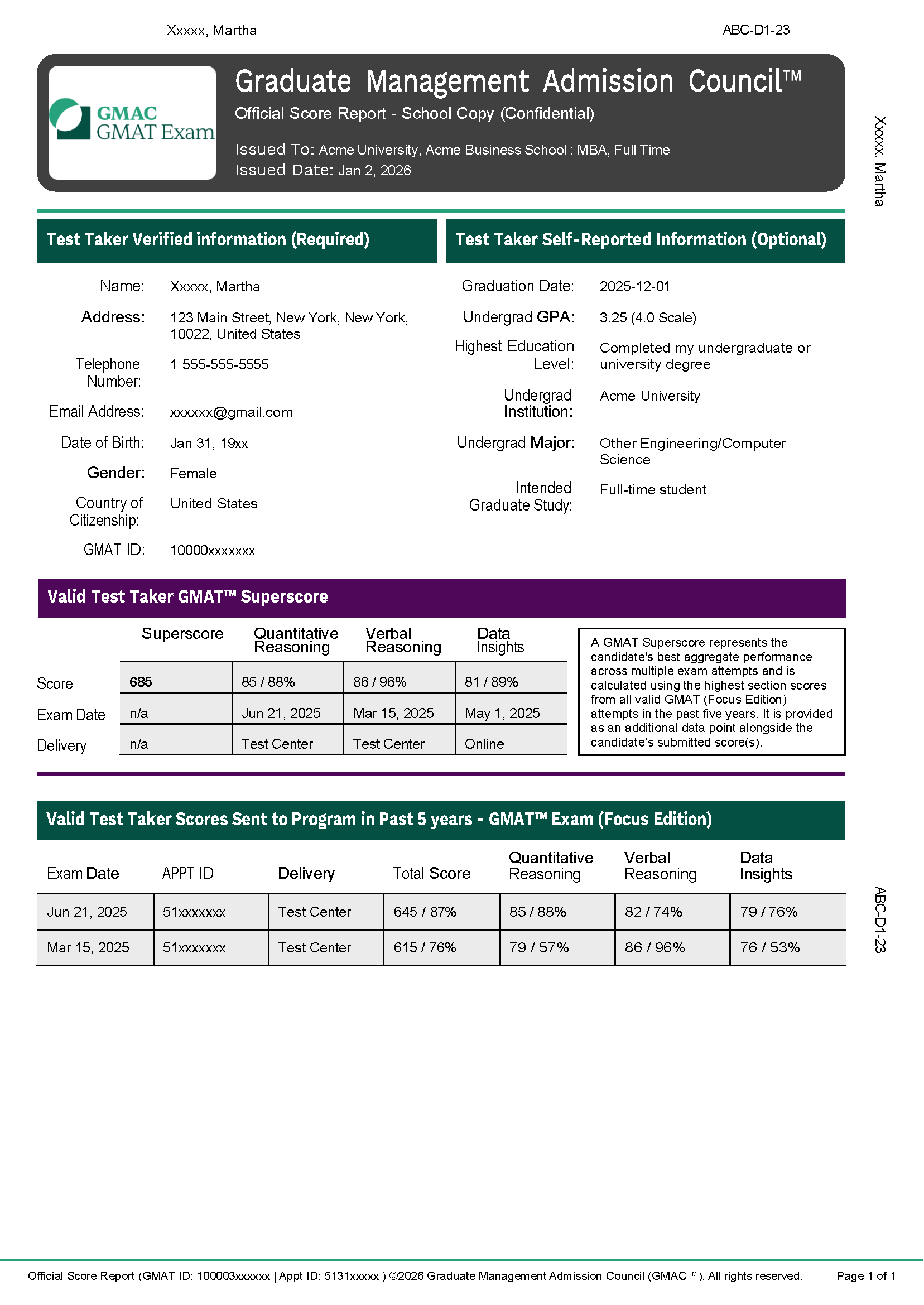
This August, GMAC will introduce GMAT Superscore — an additional score data point that represents a candidate’s best aggregate performance across multiple exam attempts. A GMAT Superscore will be automatically calculated from a candidate's highest section scores across all valid GMAT attempts (Focus Edition only) and displayed as an additional data point on GMAT Official Score Reports to help inform your admissions decisions.
We know you may have questions about how this additional data point fits into your recruitment and admissions process. As such, we have prepared a detailed FAQ to provide answers and next steps. If you have questions not covered in the FAQ, please contact your dedicated GMAC representative.
Frequently Asked Questions
Last updated May 7, 2026
What is a GMAT Superscore?
A GMAT Superscore is an additional score data point that is representative of a candidate’s best aggregate performance across all valid GMAT exam attempts of the latest edition, delivered at a test center and online. A test taker’s GMAT Superscore is calculated based on the highest section scores across these attempts.
Note: Expired and cancelled GMAT Exam (Focus Edition) scores or any GMAT Exam (10th Edition) scores are not included in the GMAT Superscore calculation.
We are currently targeting early-to-mid August to rollout GMAT Superscores. We will keep this page updated and send a follow-up communication to you once we have a confirmed launch date.
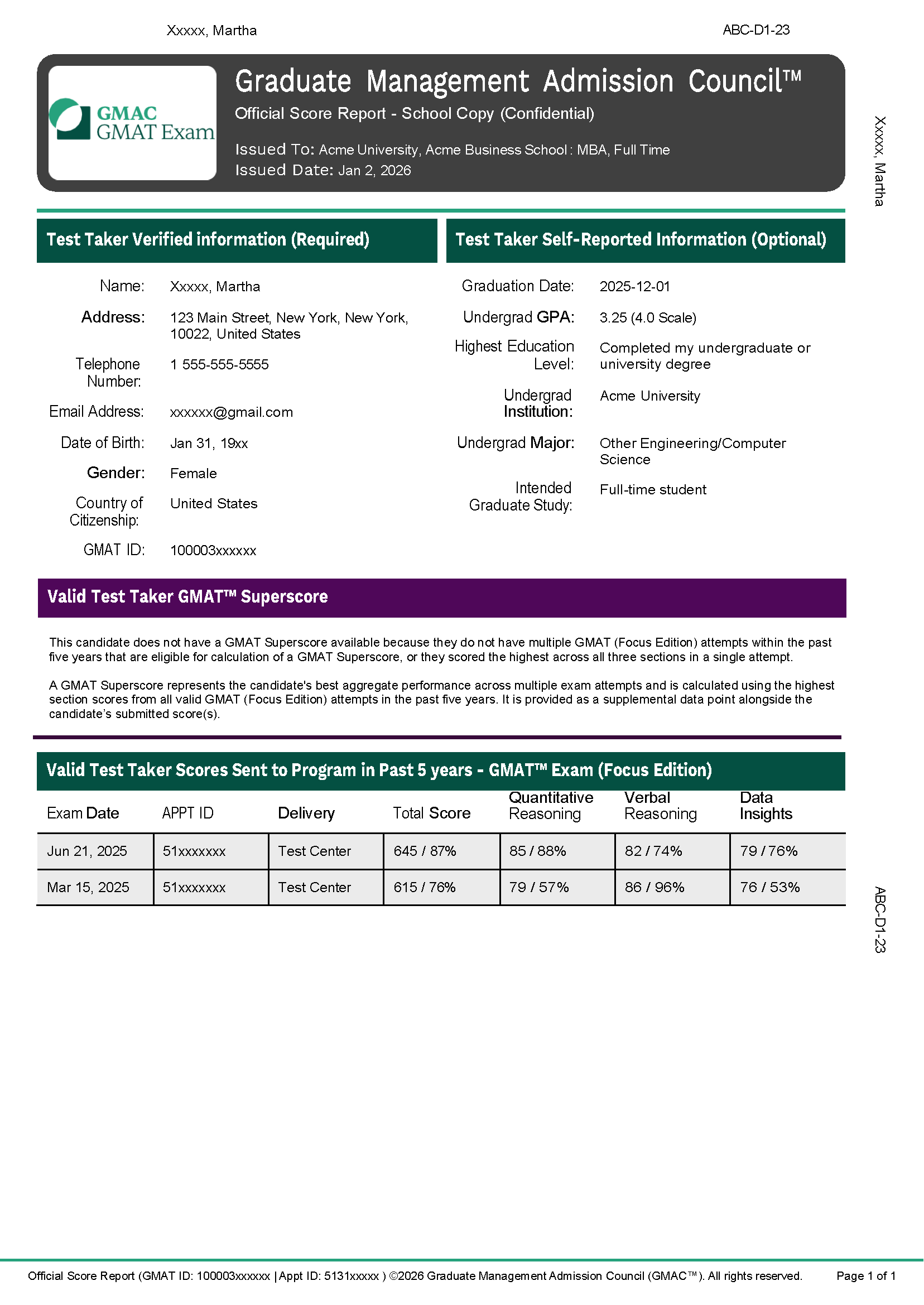
Candidates cannot opt out of sending a GMAT Superscore. If a candidate has a GMAT Superscore, it will automatically be included as part of their Official Score Report. If a candidate does not have a GMAT Superscore (because they have only taken the GMAT once), it will be made clear on the Official Score Report.
Score anxiety is one of the most significant challenges keeping qualified candidates from sending their scores. GMAT Superscore is designed to change that. Research shows that when candidates know that every attempt contributes to their strongest possible aggregate score, they test with more confidence, send scores more willingly, and consider a wider range of programs they feel prepared to apply to.
As you are likely aware, superscores are increasingly being leveraged in undergraduate admissions and graduate admissions for the SAT, ACT, and TOEFL, with promising validity studies to prove these scores are predictive of collegiate success. The ACT released a study in 2020 (“The Impact of Superscoring on the Distribution of ACT Scores”) that found ACT Superscores are better at predicting success than any other scoring methods, including using recent ACT scores or even the average ACT Composite score.
GMAC psychometricians plan to conduct validity studies in partnership with schools after GMAT Superscore’s implementation.
No, the GMAT score scale is not changing. A candidate’s GMAT Superscore will be on the same score scale as the GMAT Total Score (205–805) and may be used as an additional data point to consider when making admissions decisions. The GMAT Superscore does not have an associated percentile ranking.
No. The percentile rankings of a GMAT Total Score and corresponding section scores remain the same and are reported based on the published GMAT percentile tables. The concordance table is for linking the scores between the current edition of the GMAT to the previous edition and will remain unchanged.
A candidate’s GMAT Superscore is only intended to be used as an additional data point to consider when making admissions decisions and does not have an associated percentile ranking.
It depends. Because GMAT test takers can select which exam scores are sent to programs, it means that not all historical attempts are displayed on the score reports you receive. As a result, if a candidate has an available GMAT Superscore it will be automatically shared on the school score report in addition to the specific exam score(s) the candidate has selected to share.
However, to maintain transparency, GMAT Superscores will include the test delivery method and exam date associated with the appointment ID for each of the highest section scores.
No, only the current GMAT exam (GMAT Focus) attempts are eligible for Superscore calculation.
How do we use GMAT Superscore in admissions decisions?
GMAT Superscore is an additional data point for your consideration in making admissions decisions — a way of assessing a candidate's competitiveness, determination, and academic readiness across multiple sittings. We recommend exploring how it fits your school's unique evaluation process and needs.
Some examples of how a Superscore may be used in admissions decisions include:
-
Evaluating a candidate’s best performance on specific sections across multiple attempts,
-
Considering the dedication and stamina necessary to retest/prep for multiple attempts,
-
Providing context for future admission and waitlist considerations, or
-
Accessing an additional piece of information to support scholarship decisions.
To align with this change, new data fields will be added to the GMAT score reporting API, and new columns will be added to the CSV and TXT-format score data files downloadable from the SRP and the GMAC Downloader. As a result, you will need to update your system no later than early August to accept these newly added data fields/columns to avoid any disruption in receiving GMAT score data. Note: The file layouts are being updated to include Superscore data, but the existing candidate and exam data will remain unchanged.
You will need to make an update to your system if you’re accessing the data files from the SRP or the GMAC Downloader and are:
-
Importing the CSV or TXT-format file into a system configured by file index or column headings
-
If you use a third-party CRM, you will need to communicate these changes to your CRM provider
-
-
Retrieving scores via the score reporting API
-
When the new data fields are added, a new version of the API will be released.
-
Note: The current API will continue to run in parallel until Friday, October 30, 2026, to give you time to update your software to accommodate the new Superscore fields.
-
-
-
You can find the updated API string names, as well as the new CSV and TXT file layouts here:
- Superscore API strings
- Data file layouts:
- Sample files:
You will not need to make any updates if you're:
-
Downloading PDF-format score files
You can find the updated API string names, as well as the new CSV and TXT file layouts here:
- Superscore API strings
- Data file layouts:
- Sample files:
No. As per the GME Admissions Reporting Standards, schools should use the highest Total Score earned in one sitting when reporting the GMAT score range accepted on their websites and to global rankings. That standard remains unchanged. Superscore is a supplementary signal, not a replacement for the Total Score.
The GME Admissions Reporting Standards task force convenes every two years; we are not updating the standards at this time, but we will closely monitor the use of and preference for Superscore and we will attempt to reconvene the task force to provide guidance for external reporting purposes before the next scheduled cadence in 2028.
Once GMAT Superscore is announced to candidates in June, please use this opportunity to encourage candidates to apply with a GMAT score. Recognizing GMAT Superscore publicly signals to candidates that their full GMAT journey matters, which may increase the confidence of qualified applicants to apply to your program.
A few ways to do this:
-
Update your admissions website to note that GMAT Superscore is available and may be considered alongside a candidate's single attempt scores.
-
Brief your admissions team so they can speak to GMAT Superscore confidently if candidates ask about it.
- Reference GMAT Superscore in candidate-facing communications — such as application requirement pages or recruitment emails — to signal that multiple attempts are not discouraged (and often valued since they demonstrate commitment and determination) and that candidates' best aggregate performance will be seen and may be taken into consideration (if accurate).